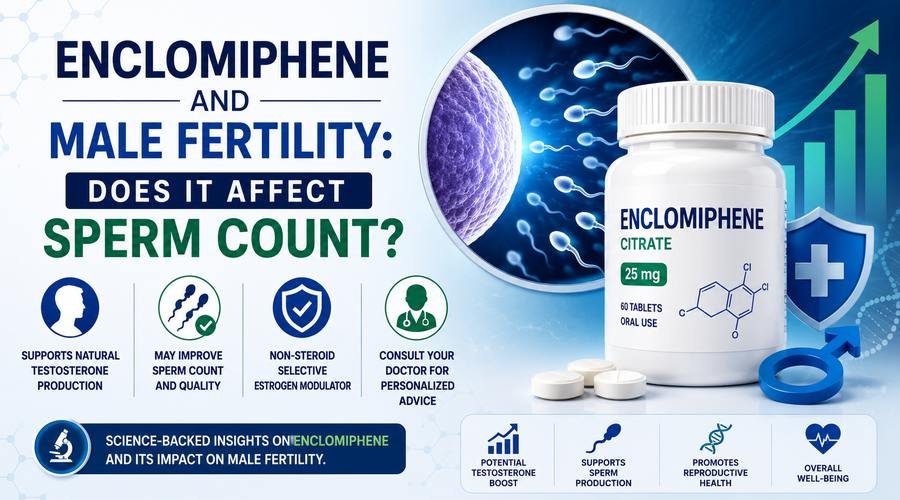
For men dealing with low testosterone who also want to preserve fertility, choosing the right treatment can be an important consideration. Enclomiphene and male fertility are often discussed together because enclomiphene works differently from conventional testosterone replacement.
Instead of supplying testosterone directly, enclomiphene is designed to stimulate the body’s own hormone-production pathway. This can increase testosterone while maintaining the hormonal signals involved in sperm production.
Research has shown that enclomiphene can increase testosterone levels while maintaining sperm concentration in men with certain forms of testosterone deficiency. However, individual results can vary, and maintaining sperm production does not guarantee pregnancy or improved fertility in every man.
Does Enclomiphene Affect Sperm Count?
Available research suggests that enclomiphene generally preserves sperm production and may improve sperm concentration in some men.
This is an important distinction from testosterone replacement therapy. External testosterone can reduce the body’s production of luteinizing hormone (LH) and follicle-stimulating hormone (FSH). Lower levels of these hormones can reduce the hormonal support required for sperm production.
Enclomiphene works through a different mechanism. It can stimulate the body’s natural hormone signalling, increasing LH and FSH and supporting testosterone production within the testes.
Key Takeaway
Enclomiphene may increase testosterone without producing the same degree of sperm suppression associated with external testosterone therapy.
However, it should not be considered a guaranteed treatment for infertility.
What Is Enclomiphene?
Enclomiphene is a selective estrogen receptor modulator (SERM). It is the trans-isomer associated with clomiphene citrate and has been studied in men with secondary hypogonadism.
Its main purpose is to encourage the body’s natural testosterone-production pathway rather than replacing testosterone directly.
The process can be simplified as:
Enclomiphene → increased hormone signalling → increased LH and FSH → testicular stimulation → increased natural testosterone production
FSH also plays an important role in supporting sperm production.
How Does Enclomiphene Work in Men?
Enclomiphene influences estrogen signalling in the hypothalamus and pituitary gland.
Under normal circumstances, estrogen provides negative feedback to the brain and pituitary. This feedback helps regulate the production of reproductive hormones.
By altering this signalling, enclomiphene can encourage the release of more LH and FSH.
These hormones then act on the testes:
- LH supports testosterone production.
- FSH supports the process involved in sperm production.
- Increased testicular hormone activity can help maintain the environment needed for spermatogenesis.
This makes the mechanism different from simply taking testosterone externally.
Enclomiphene vs Testosterone Replacement and Sperm Count
The difference between these approaches is particularly important for men who want children now or in the future.
| Factor | Enclomiphene | Testosterone Replacement |
|---|---|---|
| Main approach | Stimulates natural hormone production | Supplies testosterone externally |
| Testosterone | Can increase endogenous testosterone | Increases testosterone directly |
| LH | Can increase | May decrease |
| FSH | Can increase | May decrease |
| Sperm production | Generally preserved in studies | Can be significantly suppressed |
| Fertility consideration | May be considered for selected men | Not recommended as monotherapy when fertility is desired |
| Medical supervision | Required | Required |
External testosterone can suppress LH and FSH through hormonal feedback. This may reduce intratesticular testosterone and subsequently impair sperm production.
For this reason, men who are actively trying to conceive should discuss fertility-preserving options with a qualified healthcare professional before starting testosterone therapy.
Can Enclomiphene Increase Sperm Count?
Some studies have reported increases in sperm concentration or improvements in sperm-related measurements among men treated with enclomiphene.
However, the response is not guaranteed.
Sperm production can be affected by many factors, including:
- Age
- Testicular function
- Hormonal abnormalities
- Varicocele
- Previous testosterone or steroid use
- Obesity
- Metabolic health
- Genetic factors
- Certain infections
- Lifestyle factors
Therefore, a man with low testosterone should not assume that enclomiphene will automatically increase his sperm count.
Does Enclomiphene Improve Male Fertility?
It may support fertility-related hormone and sperm parameters, but it should not be described as a guaranteed fertility treatment.
Fertility involves much more than sperm concentration.
Important semen parameters include:
- Sperm concentration
- Total sperm count
- Sperm motility
- Sperm morphology
- Total motile sperm count
Pregnancy also depends on female reproductive health, timing and several other factors.
For this reason, an improvement in testosterone or sperm count does not automatically mean that a couple will have a higher chance of conception.
Enclomiphene and Sperm Production
Sperm production depends on a functioning hormonal system.
A simplified pathway is:
Brain → Pituitary gland → LH + FSH → Testes → Testosterone + Sperm Production
Enclomiphene works by supporting this natural pathway.
This is one of the main reasons it has attracted interest among men who have low testosterone but also want to maintain reproductive potential.
Enclomiphene for Men With Low Testosterone and Fertility Goals
Enclomiphene may be discussed with a healthcare professional when a man has:
- Low testosterone
- Secondary hypogonadism
- Reduced reproductive hormone signalling
- Current fertility goals
- A desire to avoid testosterone-related sperm suppression
Before treatment, the underlying cause of low testosterone should be evaluated.
A doctor may consider tests such as:
- Total testosterone
- Free testosterone
- LH
- FSH
- Estradiol
- Prolactin
- Semen analysis
The exact testing plan depends on the individual’s symptoms, medical history and fertility goals.
Enclomiphene After Testosterone Use
Men who have previously used testosterone or anabolic steroids can experience suppression of their natural hormone production.
This may result in:
- Low testosterone
- Reduced LH
- Reduced FSH
- Lower sperm production
- Reduced fertility
Enclomiphene may be considered in some situations to help stimulate natural hormone signalling, but treatment should be medically supervised.
Men attempting to restore fertility after testosterone or anabolic-steroid use should have their hormone levels and semen parameters evaluated rather than relying on self-treatment.
How Long Does Enclomiphene Take to Affect Sperm?
Sperm production is a gradual biological process, so changes in sperm parameters should not be expected immediately.
Hormonal changes may occur earlier, while measurable changes in semen parameters generally require more time.
For men actively trying to conceive, periodic semen analysis can provide a much clearer picture of whether sperm production is changing.
Do not increase the dose simply because sperm-count changes are not immediately visible.
Enclomiphene Side Effects
Enclomiphene can cause side effects, and individual tolerance varies.
Possible side effects may include:
- Headache
- Nausea
- Mood changes
- Changes in libido
- Breast tenderness
- Acne
- Visual disturbances
Any persistent or concerning symptoms should be discussed with a healthcare professional.
Visual changes in particular should not be ignored.
Is Enclomiphene Better Than Testosterone for Fertility?
For men whose priority is maintaining fertility while addressing low testosterone, enclomiphene may have an important advantage because it stimulates the body’s own hormone pathway rather than directly replacing testosterone.
However, “better” depends on the underlying diagnosis.
Testosterone replacement can be an appropriate treatment for certain men with confirmed testosterone deficiency, but testosterone alone can suppress sperm production.
The treatment decision should therefore consider both:
Testosterone goals + fertility goals
rather than focusing only on the testosterone number.
Enclomiphene vs Clomiphene for Male Fertility
Enclomiphene and clomiphene are related medicines.
Clomiphene contains two isomers, while enclomiphene represents the trans-isomer.
Both have been studied for hormonal treatment in men, but their clinical use and evidence base are not identical.
Some research suggests that enclomiphene can increase testosterone while maintaining sperm parameters, but more evidence is needed to determine whether it provides a consistent fertility advantage over other treatment approaches.
Important Factors That Influence Sperm Count
Even when hormone treatment is appropriate, sperm count can be affected by several lifestyle and health factors.
| Factor | Potential Impact |
|---|---|
| Obesity | May negatively affect reproductive hormones |
| Smoking | Can impair sperm quality |
| Excessive alcohol | May affect sperm production |
| Heat exposure | Can affect sperm production |
| Poor sleep | May affect hormonal health |
| Stress | Can influence reproductive health |
| Certain medicines | May affect fertility |
| Testosterone use | Can suppress sperm production |
| Varicocele | Can impair sperm production |
Improving overall health can therefore be an important part of a fertility-focused treatment plan.
Frequently Asked Questions
Does enclomiphene increase sperm count?
Enclomiphene may increase or preserve sperm concentration in some men, particularly those with secondary hypogonadism. However, individual responses vary and it is not guaranteed to increase sperm count.
Does enclomiphene reduce sperm count?
Current evidence generally suggests that enclomiphene preserves sperm production rather than causing the significant suppression commonly associated with external testosterone therapy.
Can enclomiphene increase testosterone and preserve fertility?
That is one of the main reasons enclomiphene has been studied. It can stimulate LH and FSH while increasing natural testosterone production, potentially allowing sperm production to be maintained.
Is enclomiphene a fertility medicine?
Not necessarily. It may support reproductive hormone function and sperm parameters in selected men, but it should not be presented as a guaranteed treatment for infertility.
Is enclomiphene better than testosterone replacement for fertility?
For men who want to preserve fertility, testosterone replacement alone can be problematic because it may suppress sperm production. Enclomiphene may be considered in selected men because it stimulates natural hormone production.
Can enclomiphene improve sperm motility?
Some research has reported improvements in sperm-related parameters, but evidence is not strong enough to guarantee improved motility for every man.
How long does enclomiphene take to improve sperm count?
Sperm production takes time. Hormonal changes may occur before measurable changes in semen parameters. A healthcare professional can determine the appropriate timing for follow-up semen testing.
Can enclomiphene help men trying to have children?
It may be considered for men with low testosterone and fertility goals, particularly when the problem involves secondary hypogonadism. A fertility evaluation is important before treatment.
Can you take testosterone and enclomiphene together?
This should not be done without medical supervision. External testosterone can suppress LH and FSH, which may undermine the fertility-preserving purpose of stimulating natural hormone production.
Does a higher testosterone level mean better fertility?
No. Testosterone and fertility are related but are not the same measurement. A man can have improved testosterone while still having abnormal sperm parameters.
Should sperm count be tested while taking enclomiphene?
For men actively trying to conceive or being evaluated for infertility, semen analysis can help determine sperm concentration, motility and morphology. The appropriate testing schedule should be determined by a healthcare professional.
Can enclomiphene guarantee pregnancy?
No. Even if sperm count or testosterone improves, conception depends on multiple male and female reproductive factors.
Conclusion
Enclomiphene and male fertility are closely connected because enclomiphene works by stimulating the body’s natural reproductive hormone pathway rather than directly replacing testosterone.
Research suggests that enclomiphene can increase testosterone while maintaining sperm production, making it an option that may be considered for selected men with low testosterone who also want to preserve fertility.
However, increased testosterone does not automatically mean increased fertility, and enclomiphene does not guarantee a higher chance of pregnancy.
For men with low testosterone and current or future fertility goals, the most appropriate approach is to evaluate testosterone, LH, FSH and semen parameters and discuss treatment with a qualified healthcare professional.