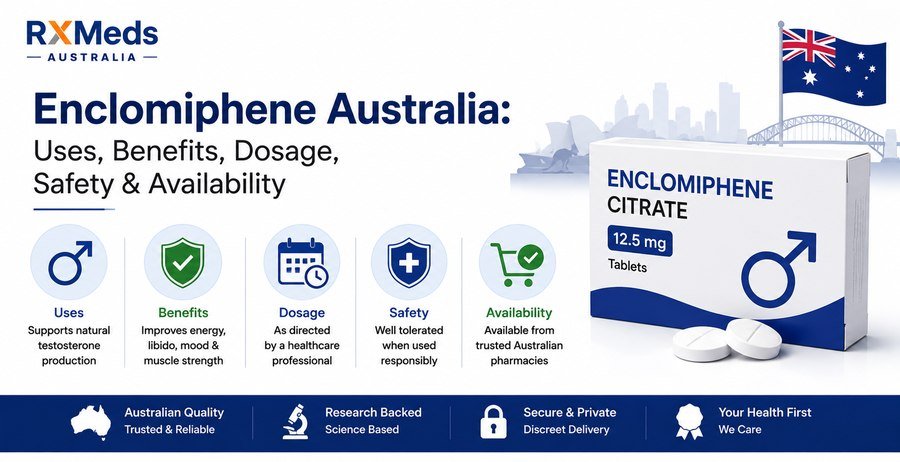
Low testosterone can affect more than energy and libido—it can also raise important questions about fertility and hormone health. This is one reason enclomiphene in Australia has attracted interest among men exploring alternatives to testosterone replacement therapy (TRT).
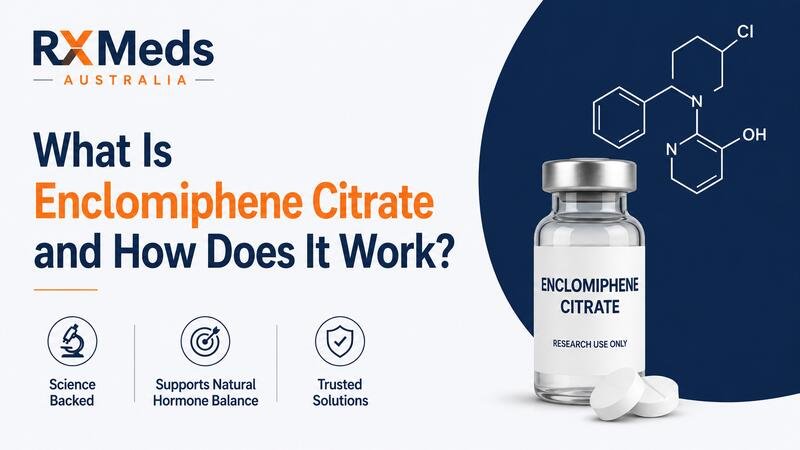
Enclomiphene is the trans-isomer of clomiphene and a selective estrogen receptor modulator (SERM). Unlike TRT, it has been studied for its potential to stimulate the body’s own testosterone production through the HPG axis, which may be relevant for men concerned about fertility.
However, enclomiphene is not a general testosterone booster, and its suitability depends on individual medical factors. If you’re researching enclomiphene Australia, availability and regulatory status are also important. Online listings do not automatically confirm approval or legal supply, so checking current TGA and ARTG information is essential.
This guide covers enclomiphene uses, potential benefits, dosage, safety, fertility, TRT comparisons, and availability in Australia.
What Is Enclomiphene?
Enclomiphene is the trans-isomer of clomiphene, a selective estrogen receptor modulator.
It has been investigated primarily in men with secondary hypogonadism, a condition where inadequate signalling from the hypothalamus or pituitary can contribute to low testosterone production.
The pituitary gland produces two important reproductive hormones:
- LH (luteinising hormone): stimulates testosterone production in the testes.
- FSH (follicle-stimulating hormone): plays an important role in sperm production.
Enclomiphene has been studied because it can influence estrogen feedback and increase LH and FSH signalling. Clinical research has reported increases in testosterone and LH in men with secondary hypogonadism.
Enclomiphene vs TRT
The basic difference is straightforward:
TRT supplies testosterone externally, while enclomiphene is intended to stimulate endogenous testosterone production.
This difference can be clinically relevant for men concerned about fertility.
How Does Enclomiphene Work?
Enclomiphene influences the hypothalamic-pituitary-gonadal (HPG) axis, which regulates testosterone production and male reproductive function.
As a selective estrogen receptor modulator (SERM), it alters estrogen feedback in the hypothalamus and pituitary. This can increase LH and FSH signalling, encouraging the testes to produce more of their own testosterone.
Unlike TRT, which supplies testosterone externally, enclomiphene aims to support the body’s natural testosterone-production pathway. Clinical research has reported increased testosterone and LH in men with secondary hypogonadism.
What Is Enclomiphene Used For?
Enclomiphene has mainly been studied in men with secondary hypogonadism and testosterone deficiency.
It may be considered in selected clinical situations involving:
- Secondary hypogonadism
- Low testosterone associated with impaired hormonal signalling
- Men interested in maintaining endogenous testosterone production
- Men where fertility is an important treatment consideration
However, not every man with low testosterone is automatically a candidate.
Symptoms such as fatigue, low libido, or reduced muscle strength can have multiple causes. Proper diagnosis may involve repeat testosterone testing and assessment of LH, FSH, and other relevant markers.
Potential Benefits of Enclomiphene
May Increase Endogenous Testosterone
Clinical research has shown that enclomiphene can increase serum testosterone in selected men with secondary hypogonadism.
May Support Reproductive Hormonal Signalling
Unlike external testosterone, enclomiphene has been studied for its ability to increase LH and FSH. This makes its hormonal mechanism particularly relevant to men concerned about reproductive function.
May Be Relevant to Fertility
Studies have investigated enclomiphene in men with secondary hypogonadism and found that testosterone can increase without the same suppression of sperm production observed with testosterone replacement.
However, this does not mean enclomiphene guarantees improved fertility. Male fertility can be affected by many factors, including sperm quality, varicocele, genetics, medications, and hormonal disorders.
Enclomiphene Dosage: What Does Research Show?
There is no universal personal dosage that is appropriate for everyone.
Clinical research has evaluated different doses, including 6.25 mg, 12.5 mg, and 25 mg daily in men with secondary hypogonadism.
These are research doses, not instructions for self-treatment.
| Research dose | Context |
|---|---|
| 6.25 mg | Studied in clinical research |
| 12.5 mg | Studied in clinical research |
| 25 mg | Higher research dose |
| Daily dosing | Evaluated in clinical studies |
| Personal dose | Requires clinician assessment |
A clinician may consider testosterone levels, LH/FSH, symptoms, fertility goals, medical history and treatment response before deciding on an appropriate treatment strategy.
How Long Does Enclomiphene Take to Work?
Individual responses vary.
Clinical studies have reported hormonal changes during treatment, but the timeline depends on baseline hormone levels, underlying health, treatment strategy and individual response.
Follow-up blood testing is more useful than relying on a fixed online timeline.
Patients should also avoid assuming that increasing the dose will necessarily produce better results.
Enclomiphene Side Effects and Safety
Because enclomiphene affects the endocrine system, potential side effects and monitoring requirements should be taken seriously, especially when considering long-term enclomiphene use.
Possible concerns can include:
- Headache
- Mood changes
- Visual symptoms
- Hormonal changes
- Changes in estradiol
- Gastrointestinal symptoms
New or unusual visual symptoms should be reported promptly to a healthcare professional.
Monitoring
Depending on the clinical situation, a doctor may evaluate:
- Total testosterone
- Free testosterone
- LH
- FSH
- Estradiol
- Prolactin
- Semen parameters when fertility is relevant
The goal is not simply to increase testosterone as much as possible. Treatment should address clinically significant deficiency while considering safety and reproductive goals.
Enclomiphene vs Clomiphene
Although they are closely related, enclomiphene and clomiphene are not identical. Enclomiphene is the trans-isomer of clomiphene, while clomiphene contains multiple stereoisomers.
Understanding the difference between enclomiphene and Clomid can help men better understand how these two treatments differ in terms of mechanism, research, and potential clinical use.
| Feature | Enclomiphene | Clomiphene |
|---|---|---|
| Drug class | SERM | SERM |
| Relationship | Trans-isomer | Mixture of stereoisomers |
| Male hormone research | Yes | Yes |
| HPG-axis effects | Can increase LH/FSH | Influences estrogen feedback |
| Regulatory status | Depends on jurisdiction | Depends on jurisdiction |
Their chemical relationship does not mean they have identical clinical indications or regulatory status.
Enclomiphene vs TRT
Enclomiphene and TRT work through fundamentally different approaches. TRT supplies testosterone externally, while enclomiphene is intended to stimulate endogenous testosterone production. That distinction can be particularly important for men who want to maintain reproductive hormone signalling.
Testosterone replacement therapy is a commonly used approach for managing clinically confirmed testosterone deficiency, but its effects on natural hormone production and fertility should also be considered.
| Factor | Enclomiphene | TRT |
|---|---|---|
| Main approach | Stimulates endogenous production | Supplies testosterone |
| LH/FSH | May increase signalling | Can suppress signalling |
| Endogenous testosterone | Stimulates pathway | May suppress production |
| Fertility | Important consideration | Requires fertility discussion |
| Treatment choice | Patient-specific | Patient-specific |
For men who are actively trying to conceive, fertility should be discussed before starting testosterone therapy.
Neither treatment should automatically be considered “better.” The appropriate option depends on the underlying diagnosis and treatment goals.
Enclomiphene Australia: Availability and Regulatory Status
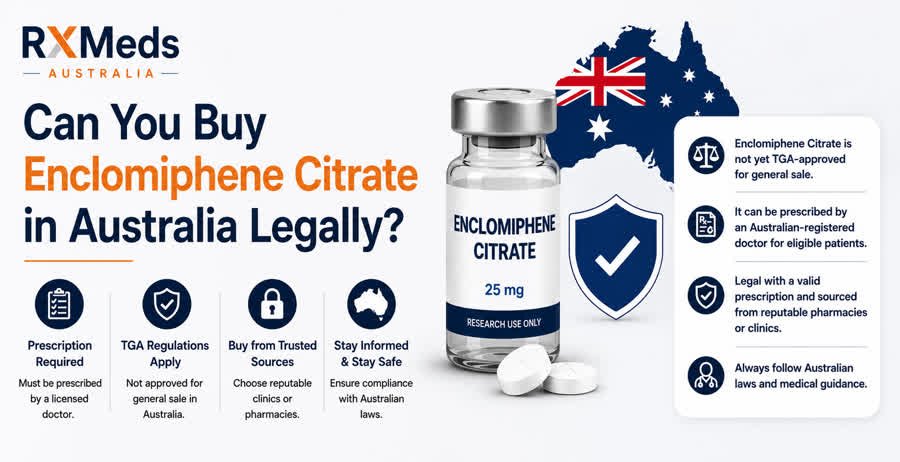
One of the most important questions for Australian readers is whether enclomiphene is legally available.
If you’re considering treatment, it’s important to understand whether enclomiphene can be legally purchased in Australia and what regulatory requirements may apply.
The answer depends on the specific product, formulation and regulatory pathway.
The TGA’s ARTG is the public database used to identify therapeutic goods that can legally be supplied in Australia.
A website advertising “enclomiphene Australia” does not automatically prove that its product is TGA-approved or legally supplied.
Consumers should check:
| What to check | Why it matters |
|---|---|
| ARTG status | Helps verify regulatory status |
| Product identity | Confirms what is actually being supplied |
| Manufacturer/sponsor | Establishes product responsibility |
| Pharmacy credentials | Helps avoid unknown sellers |
| Prescription requirements | Ensures appropriate medical oversight |
Can You Buy Enclomiphene Online in Australia?
Online availability should not be confused with legitimate medical supply.
The TGA warns that medicines purchased from unknown online sources may be counterfeit, contain incorrect quantities of active ingredients or contain undisclosed substances.
Consumers should be particularly cautious with websites that:
- Sell prescription medicines without appropriate medical assessment
- Make unrealistic medical claims
- Do not clearly identify the supplier
- Appear Australian but operate overseas
- Provide no reliable regulatory information
Before purchasing or importing any medicine, check current TGA requirements and speak with an Australian doctor or pharmacist.
Enclomiphene and Male Fertility
Fertility is one of the main reasons enclomiphene is of interest.
External testosterone can suppress LH and FSH, which can affect sperm production. Enclomiphene has been investigated because it can stimulate endogenous hormonal signalling instead.
In clinical research, enclomiphene increased testosterone while maintaining sperm counts in studied men with secondary hypogonadism.
However, fertility is more complicated than testosterone levels alone.
Factors such as sperm concentration, motility, morphology, varicocele, genetics, medications and other health conditions can all affect fertility.
Men actively trying to conceive should discuss their fertility goals with a qualified healthcare professional before starting hormone treatment.
Enclomiphene Blood Tests and Monitoring
Blood testing helps establish whether testosterone deficiency is present and whether treatment is producing the intended hormonal response.
Depending on the patient, testing may include:
- Testosterone
- LH
- FSH
- Estradiol
- Prolactin
- Other relevant investigations
When fertility is a priority, semen analysis may also be appropriate.
The aim is to manage the underlying condition safely—not simply to achieve the highest possible testosterone number.
Frequently Asked Questions
1. What is enclomiphene?
Enclomiphene is the trans-isomer of clomiphene and a selective estrogen receptor modulator studied for increasing endogenous testosterone in selected men with secondary hypogonadism.
2. Does enclomiphene increase testosterone?
Clinical studies have reported increased testosterone and LH in men with secondary hypogonadism treated with enclomiphene.
3. What is enclomiphene used for?
It has mainly been studied in men with secondary hypogonadism and testosterone deficiency.
4. What is the usual enclomiphene dosage?
There is no universal personal dose. Research has evaluated doses including 6.25 mg, 12.5 mg and 25 mg, but these should not be used as self-prescribing instructions.
5. Is enclomiphene the same as clomiphene?
No. Enclomiphene is the trans-isomer of clomiphene, while clomiphene contains multiple stereoisomers.
6. Does enclomiphene affect fertility?
It may be relevant to fertility because it stimulates endogenous reproductive hormone signalling. However, it cannot guarantee improved fertility.
7. Is enclomiphene better than TRT?
Not necessarily. They work differently, and the appropriate treatment depends on diagnosis, fertility goals, and individual circumstances.
8. Is enclomiphene available in Australia?
Availability and legal supply depend on the specific product and regulatory pathway. Australian regulatory information should be checked before purchasing.
9. Can I buy enclomiphene online in Australia?
Consumers should be cautious. The TGA warns about counterfeit and unapproved medicines sold through unknown online sources.
10. What are the side effects of enclomiphene?
Potential concerns may include headache, mood changes, visual symptoms, and hormonal changes. Persistent or concerning symptoms should be discussed with a healthcare professional.
Conclusion
Enclomiphene is a SERM that has been studied as a potential treatment approach for selected men with secondary hypogonadism and low testosterone.
Its main difference from TRT is how it works. Rather than supplying testosterone externally, enclomiphene aims to stimulate the body’s own testosterone-producing pathway. This makes its potential relationship with fertility particularly relevant for some men.
Clinical research has reported increases in testosterone and LH, while studies have also investigated sperm preservation during treatment. However, enclomiphene is not suitable for everyone with low testosterone, and research doses should not be treated as personalised prescribing instructions.
For Australians, the question of availability, legality and product quality is equally important. A product advertised online is not automatically an approved or legally supplied medicine. Consumers should check current TGA information, verify the product and supplier, and discuss treatment with a qualified Australian healthcare professional.
Ultimately, the right approach is not simply to find an enclomiphene product or dosage online. The priority should be establishing the cause of low testosterone, understanding fertility goals and choosing an evidence-based treatment strategy under appropriate medical supervision.
Medical disclaimer: This article is for educational purposes only and does not provide personalised medical advice, diagnosis or prescribing instructions. Dosage and treatment decisions should be made with a qualified healthcare professional.