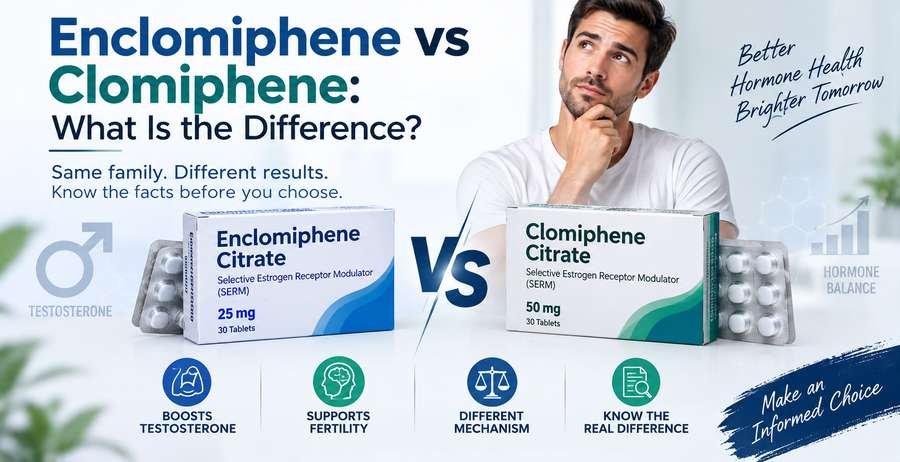
Enclomiphene and clomiphene are closely related medicines that are attracting attention among men being evaluated for low testosterone, particularly when maintaining fertility is an important consideration. Although both belong to a group of medicines called selective estrogen receptor modulators (SERMs), they are not identical.
The difference becomes particularly important in Australia because medicine availability, approval status and access pathways are regulated by the Therapeutic Goods Administration (TGA). A medicine being discussed online or used overseas does not necessarily mean that the same product is approved or routinely available in Australia.
This guide explains the key differences between enclomiphene and clomiphene, how they work, what research says, and what Australian patients should know about access and safety.
What Is Clomiphene?
Clomiphene, usually referred to as clomiphene citrate, is a selective estrogen receptor modulator. It has a long history of medical use, particularly in fertility treatment.
Clomiphene works partly by interfering with estrogen feedback at the hypothalamus and pituitary gland. This can increase the release of gonadotropins, particularly luteinising hormone (LH) and follicle-stimulating hormone (FSH). In men, increased LH can stimulate the testes to produce more testosterone, while FSH has an important role in sperm production.
Because clomiphene stimulates the body’s own hormonal signalling rather than directly replacing testosterone, it has been investigated and used in selected men with hypogonadism, particularly when preservation of fertility is relevant.
However, its use in men can be different from its primary approved indication, so treatment decisions should be made by a qualified clinician.
What Is Enclomiphene?
Enclomiphene Citrate 50 mg is one of the two stereoisomers associated with clomiphene citrate. Clomiphene contains both enclomiphene and zuclomiphene components.
Enclomiphene has attracted particular interest in men’s health because research has investigated it as a treatment for secondary or functional hypogonadism.
Like clomiphene, Enclomiphene Australia medicine acts through estrogen receptors and can increase LH and FSH signalling. The objective is to encourage the testes to produce testosterone naturally rather than supplying testosterone from outside the body.
This distinction is important because external testosterone therapy can suppress the body’s LH and FSH production and, consequently, sperm production.
Enclomiphene vs Clomiphene: Key Differences
| Feature | Clomiphene | Enclomiphene |
|---|---|---|
| Drug class | SERM | SERM |
| Composition | Contains enclomiphene and zuclomiphene isomers | Enclomiphene isomer |
| Main area of established use | Fertility treatment, particularly ovulation induction | Investigated primarily for male hypogonadism |
| Effect on LH/FSH | Can increase LH and FSH | Can increase LH and FSH |
| Effect on testosterone | Can increase endogenous testosterone in selected men | Can increase endogenous testosterone |
| Fertility consideration | May be considered when fertility preservation matters | Studied specifically in contexts where endogenous testosterone and fertility are important |
| Evidence base | Longer history of clinical use | More limited clinical experience |
| Australian access | Depends on the specific registered product and indication | Regulatory/access status should be verified for the specific product |
The most important point is that enclomiphene should not simply be described as “clomiphene without side effects.” The available evidence does not establish that one option is universally superior for every patient.
How Do They Work in Men?
The body’s reproductive hormone system can be simplified into three major levels:
Hypothalamus → Pituitary gland → Testes
The hypothalamus helps regulate reproductive hormone signalling. The pituitary then releases LH and FSH. LH stimulates testosterone production in the testes, while FSH supports spermatogenesis.
Estrogen normally provides negative feedback to this system. SERMs such as clomiphene and enclomiphene can modify estrogen receptor signalling, reducing some of this feedback and encouraging increased LH and FSH secretion.
As a result, testosterone production may increase while the reproductive hormone system remains active.
This is different from testosterone replacement therapy (TRT), where testosterone is supplied externally.
Enclomiphene vs Clomiphene for Testosterone
Clinical research supports the ability of SERMs to increase testosterone in appropriately selected men.
A 2025 systematic review and meta-analysis of randomized controlled trials evaluated clomiphene and enclomiphene in men with functional hypogonadism. Compared with placebo, SERM treatment significantly increased total testosterone, LH and FSH. The analysis also found no significant difference in total testosterone between SERM therapy and testosterone gel groups.
However, these results do not mean that every man with low testosterone should take a SERM. Low testosterone can have different causes, and treatment depends on the underlying diagnosis.
Doctors may consider factors such as testosterone measurements, LH and FSH levels, symptoms, reproductive plans, medical history and other possible causes of hormonal abnormalities.
What About Fertility?
Fertility is one of the major reasons SERMs receive attention in men’s health.
External testosterone can reduce LH and FSH production through negative feedback. This can reduce stimulation of the testes and potentially decrease sperm production.
By contrast, clomiphene and enclomiphene aim to stimulate the body’s own reproductive hormone pathway.
That does not mean either medicine guarantees fertility preservation. Men actively trying to conceive may require a dedicated fertility assessment, including semen analysis and hormonal testing.
A treatment that increases testosterone is not automatically the correct fertility treatment.
Enclomiphene vs Clomiphene Side Effects
Both medicines can cause adverse effects, and the risk varies by individual.
Potential effects associated with SERM therapy may include:
- Headache
- Nausea or gastrointestinal symptoms
- Mood changes
- Changes in estrogen levels
- Breast tenderness
- Acne or other hormone-related effects
- Visual symptoms
Visual disturbances are particularly important to report to a doctor promptly.
The safety profile of a medicine should not be judged solely from online testimonials. Clinical history, dose, duration of treatment and other medicines can all influence risk.
Enclomiphene in Australia: Is It Approved?
This is where Australian patients need to be particularly careful.
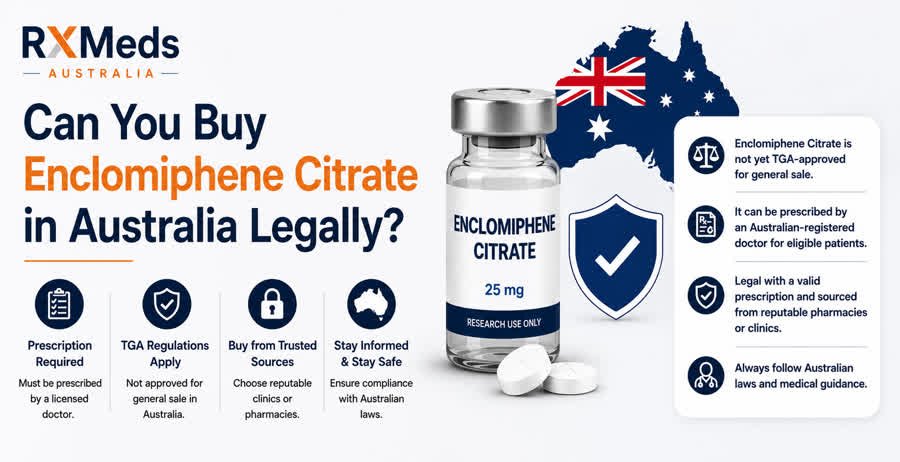
In Australia, therapeutic goods generally need to be included in the Australian Register of Therapeutic Goods (ARTG) before they can be legally supplied. Products that are not included in the ARTG are considered unapproved therapeutic goods and have not been assessed by the TGA for safety, quality and effectiveness.
The regulatory status should therefore be checked for the specific enclomiphene product, rather than assuming that an overseas product is automatically approved in Australia.
The TGA does provide pathways through which certain unapproved therapeutic goods may be accessed in specific circumstances. These include the Special Access Scheme (SAS), Authorised Prescriber Scheme, clinical-trial pathways and, in certain circumstances, personal importation.
Patients cannot independently use the SAS or Authorised Prescriber pathways; appropriate access involves a registered health practitioner and specific regulatory requirements.
Can You Buy Enclomiphene Online in Australia?
Consumers should be cautious about websites selling enclomiphene without appropriate medical oversight.
An online product may not have been evaluated by the TGA, and the quality, strength or ingredients may not necessarily match what is stated on the website.
Australian consumers should discuss treatment with a qualified medical practitioner and obtain medicines through legitimate channels.
The TGA specifically notes that unapproved therapeutic goods have not been assessed for safety, quality or effectiveness, which is an important consideration when purchasing medicines online.
Which Is Better: Enclomiphene or Clomiphene?
There is no universal answer.
The appropriate option depends on the individual’s diagnosis, fertility goals, hormone profile, previous treatment, medical history and the availability and regulatory status of the relevant product.
Research suggests that both clomiphene and enclomiphene can influence testosterone and gonadotropin levels in men with functional hypogonadism. However, the evidence base is not sufficient to conclude that enclomiphene is categorically better than clomiphene for all patients.
For Australian patients, regulatory status is another important consideration alongside clinical evidence.
Frequently Asked Questions
Is enclomiphene the same as clomiphene?
No. Enclomiphene is one of the stereoisomers associated with clomiphene citrate. Clomiphene contains both enclomiphene and zuclomiphene components.
Can clomiphene increase testosterone in men?
Yes. Clinical studies have shown that clomiphene can increase endogenous testosterone in selected men, partly by increasing LH and FSH signalling.
Does enclomiphene increase testosterone?
Clinical trials have investigated enclomiphene for male hypogonadism, and research indicates that it can increase endogenous testosterone and gonadotropins in appropriately selected patients.
Is enclomiphene TGA-approved in Australia?
The status should be checked for the specific product in the current ARTG. A product that is not listed in the ARTG is considered an unapproved therapeutic good and may only be accessed through applicable regulatory pathways.
Can enclomiphene preserve fertility?
SERMs are of interest because they stimulate endogenous reproductive hormone signalling rather than directly replacing testosterone. However, individual fertility outcomes vary, and men trying to conceive should receive appropriate medical and fertility assessment.
Final Takeaway
Enclomiphene and clomiphene are closely related SERMs, but they are not identical medicines. Both can stimulate the body’s natural reproductive hormone pathway and have been studied for increasing testosterone in selected men.
The major differences involve their composition, clinical history, evidence base and regulatory considerations. For Australians, the TGA status and legal access pathway of the specific product are especially important.
Most importantly, the choice between clomiphene, enclomiphene, testosterone replacement or another treatment should be based on an individual’s diagnosis and treatment goals rather than internet comparisons or anecdotal experiences.