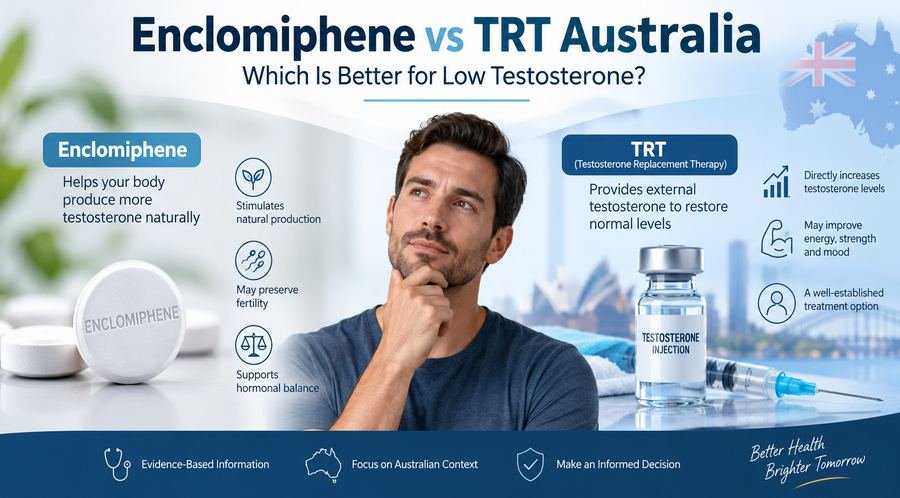
Enclomiphene vs TRT is becoming an important question for Australian men experiencing low testosterone, particularly those who want to improve testosterone levels without compromising fertility.
Both approaches can increase testosterone, but they work in very different ways.
Testosterone replacement therapy (TRT) provides testosterone from outside the body. Enclomiphene, by contrast, is a selective oestrogen receptor modulator (SERM) that aims to stimulate the body’s own testosterone production by increasing luteinising hormone (LH) and follicle-stimulating hormone (FSH).
That difference can be particularly important for men who want to preserve sperm production.
Clinical trials have found that enclomiphene can increase testosterone in men with secondary hypogonadism while maintaining sperm concentrations, whereas testosterone gel suppresses LH and FSH and can markedly reduce sperm production.
However, enclomiphene and TRT should not be treated as interchangeable therapies, and enclomiphene’s regulatory status and availability in Australia need to be considered before treatment.
The right choice depends on the cause of low testosterone, fertility plans, symptoms, blood-test results and individual health risks.
Enclomiphene vs TRT: Quick Comparison
| Factor | Enclomiphene | Testosterone Replacement Therapy (TRT) |
|---|---|---|
| How it works | Stimulates the body’s own testosterone production | Replaces testosterone directly |
| Main hormonal effect | Increases LH and FSH | Usually suppresses LH and FSH |
| Testosterone | Increases endogenous testosterone | Increases circulating testosterone directly |
| Sperm production | Generally preserved in clinical trials | Can be substantially suppressed |
| Fertility | Potential advantage when fertility is important | Can impair fertility |
| Administration | Oral in clinical studies | Depending on product, may include gels, creams or injections |
| Australian regulatory considerations | Not equivalent to an established PBS testosterone product; availability and prescribing require professional assessment | Testosterone products are available in Australia, with some listed on the PBS under authority requirements |
| Evidence base | Promising but more limited | Larger and more established |
| Most relevant population | Selected men with secondary/functional hypogonadism, especially when fertility matters | Men with confirmed androgen deficiency who are appropriate candidates for testosterone replacement |
Australian testosterone prescribing is subject to clinical and regulatory considerations, and testosterone products listed on the PBS are authority-required medicines.
What Is Enclomiphene?
Enclomiphene is the trans-isomer of clomiphene and belongs to the selective oestrogen receptor modulator (SERM) class.
Unlike TRT, it does not directly supply testosterone.
Instead, enclomiphene can influence the hypothalamic-pituitary-testicular axis. By reducing oestrogen-mediated negative feedback, it can increase signalling from the pituitary gland.
This can increase:
- LH (luteinising hormone)
- FSH (follicle-stimulating hormone)
- Testicular testosterone production
- Support for spermatogenesis
This is why enclomiphene is sometimes described as a testosterone restoration approach rather than testosterone replacement.
In a randomised phase II trial involving men with secondary hypogonadism, enclomiphene increased morning testosterone similarly to topical testosterone while increasing LH and FSH and preserving sperm counts.
What Is Testosterone Replacement Therapy (TRT)?
Testosterone replacement therapy, commonly called TRT, supplies testosterone directly to men with clinically confirmed testosterone deficiency.
Australian testosterone preparations can include topical products such as gels and creams as well as other formulations.
The Endocrine Society of Australia states that androgen deficiency should be diagnosed clinically and confirmed with appropriate hormone testing before testosterone replacement is started.
The goal of TRT is not simply to achieve the highest possible testosterone number.
The aim is to restore testosterone to an appropriate physiological range while monitoring the patient’s symptoms, hormone levels and potential adverse effects.
For example, the Australian PBS currently lists testosterone products including testosterone 1% gel, testosterone 2% gel and testosterone 5% cream, with authority requirements applying to listed products.
How Does Enclomiphene Work Compared With TRT?
The easiest way to understand the difference is to look at the body’s hormonal feedback system.
TRT
TRT introduces testosterone from an external source.
The simplified pathway is:
External testosterone → increased blood testosterone → negative feedback → lower LH/FSH → reduced testicular stimulation
This suppression can reduce intratesticular testosterone and sperm production.
Enclomiphene
Enclomiphene takes a different approach:
Enclomiphene → increased LH/FSH signalling → testicular stimulation → increased endogenous testosterone
This means the testes continue receiving hormonal signals that are important for testosterone production and spermatogenesis.
This distinction is one of the most important factors when comparing enclomiphene vs TRT for fertility.
Enclomiphene vs TRT for Testosterone Levels
Both treatments can increase testosterone, but clinical trials suggest they do so through different mechanisms.
In one pharmacodynamic study, men taking 25 mg of enclomiphene daily had a mean testosterone concentration of approximately 604 ng/dL after six weeks, compared with approximately 500 ng/dL with transdermal testosterone. The difference between the groups was not statistically significant in that study.
The same study found that testosterone levels increased within approximately two weeks with both treatments, while their effects on LH and FSH were opposite.
A later randomised phase III programme involving overweight men aged 18–60 with secondary hypogonadism found that enclomiphene increased testosterone while maintaining sperm concentration. Testosterone gel also increased testosterone but markedly reduced spermatogenesis.
A 2025 systematic review and meta-analysis of randomised controlled trials found that SERM therapy increased total testosterone by an average of approximately 274 ng/dL compared with placebo. It also increased LH and FSH. The researchers found no significant difference in testosterone between SERM therapy and testosterone gel in the analysed comparisons.
What does this mean?
The available evidence suggests that enclomiphene can raise testosterone substantially in appropriately selected men, particularly those with functional or secondary hypogonadism.
But a higher testosterone number does not automatically mean one treatment is clinically better for every patient.
Enclomiphene vs TRT and Male Fertility
For Australian men considering testosterone treatment, fertility is an important issue that should be discussed before starting TRT.
Exogenous testosterone can suppress LH and FSH.
Because these hormones help maintain testicular testosterone production and sperm development, TRT can substantially reduce sperm production.
Australian clinical guidance has highlighted this concern. The RACGP notes that testosterone therapy does not improve fertility and may suppress spermatogenesis because of gonadotrophin suppression.
The Endocrine Society of Australia also lists desired fertility as an important precaution when considering testosterone treatment.
What happens to sperm on TRT?
The pathway can be simplified as:
TRT → lower LH/FSH → lower intratesticular testosterone → reduced sperm production
In some men, sperm production can fall dramatically and may become temporarily absent.
Recovery can occur after testosterone is stopped, but the time required varies between individuals.
For this reason, men who are actively trying to conceive should not assume that TRT is a suitable treatment for low testosterone.
Can Enclomiphene Preserve Fertility?
This is where enclomiphene Citrate 50 has one of its most important potential advantages.
In randomised clinical studies of men with secondary hypogonadism, enclomiphene increased testosterone while maintaining sperm concentrations, whereas testosterone gel produced a marked reduction in spermatogenesis.
An earlier study also reported increases in testosterone and sperm counts in men receiving enclomiphene, with associated increases in LH and FSH.
Therefore, for a man with low testosterone who also wants to preserve fertility, a treatment that stimulates endogenous testosterone production may be worth discussing with an endocrinologist, urologist or fertility specialist.
However, preserving sperm production does not mean enclomiphene is guaranteed to improve fertility or pregnancy rates.
Fertility is influenced by sperm quality, female partner factors, reproductive anatomy, age and many other variables.
Is Enclomiphene Better Than TRT for Fertility?
For appropriately selected men with secondary hypogonadism and an active fertility goal, enclomiphene may offer an important advantage because clinical studies have shown preservation of sperm production.
TRT, on the other hand, can suppress spermatogenesis.
This does not mean enclomiphene should automatically replace TRT.
The Australian Endocrine Society emphasises that testosterone therapy should be used for established androgen deficiency rather than for nonspecific symptoms or simply because testosterone is lower than expected.
The underlying cause of low testosterone therefore needs to be established first.
Enclomiphene vs TRT: Side Effects and Safety
Neither approach should be considered risk-free.
Potential TRT side effects
Testosterone treatment can cause or contribute to issues such as:
- Increased haematocrit/polycythaemia
- Acne
- Suppression of sperm production
- Fluid retention
- Changes in breast tissue
- Changes in prostate-related markers
- Worsening of some pre-existing conditions
The Endocrine Society of Australia identifies conditions requiring caution or further assessment before testosterone treatment, including untreated polycythaemia, severe untreated obstructive sleep apnoea, certain prostate abnormalities and unstable cardiac disease.
Testosterone treatment therefore requires medical supervision and ongoing monitoring.
Potential enclomiphene side effects
The safety evidence for enclomiphene is less extensive than the evidence for established testosterone products.
Potential SERM-related adverse effects may include:
- Headache
- Mood changes
- Visual symptoms
- Breast tenderness
- Changes in oestradiol
- Gastrointestinal symptoms
The actual risk depends on the drug, dose, duration and individual patient.
Importantly, fertility preservation should not be confused with overall safety superiority.
There is currently less long-term clinical evidence for enclomiphene than for conventional testosterone replacement.
Is Enclomiphene Approved in Australia?
This is an important issue for Australian readers.
Enclomiphene should not be presented online as though it has the same regulatory status as standard testosterone medicines available in Australia.
The Therapeutic Goods Administration (TGA) regulates medicines supplied in Australia. Products that have not been evaluated or authorised for supply through the appropriate Australian regulatory pathways should not be treated as equivalent to registered medicines.
The TGA has also warned Australians about purchasing unapproved health products from overseas websites, noting that such products may not have been assessed for safety, quality or effectiveness.
Therefore, Australians should be particularly cautious about websites selling “enclomiphene” directly without appropriate medical and pharmacy oversight.
Do not assume that a product is safe, genuine or legally supplied simply because it is advertised online.
For an Australian patient, the practical questions are:
- Is the product legally available for the intended use?
- Is it supplied through an appropriate Australian pharmacy or prescribing pathway?
- Is the product quality assured?
- Is the treatment being prescribed by a qualified Australian clinician?
- Is appropriate laboratory monitoring being performed?
TRT in Australia: What Patients Should Know
Testosterone is available in Australia in several prescription formulations.
The PBS currently lists testosterone products including:
- Testosterone 1% gel
- Testosterone 2% gel
- Testosterone 5% cream
These listings carry Authority Required requirements.
The Australian regulatory and reimbursement environment is therefore different from the United States.
Patients should not assume that a testosterone treatment advertised overseas will have the same availability, prescribing requirements or PBS coverage in Australia.
The Endocrine Society of Australia has also noted that testosterone prescribing in Australia has been subject to tighter criteria, particularly where there is no established pituitary or testicular disorder.
Who Might Be a Candidate for Enclomiphene?
Enclomiphene is most relevant to men whose low testosterone is associated with secondary or functional hypogonadism, where the testes can still respond to increased LH and FSH stimulation.
A clinician may consider this type of treatment particularly relevant when:
- Testosterone is repeatedly low
- Symptoms are consistent with androgen deficiency
- LH and FSH are low or inappropriately normal
- Fertility is important
- The testes retain functional capacity
- There is a clinical reason to stimulate endogenous testosterone production
However, enclomiphene may be less effective in primary testicular failure, where the testes themselves cannot adequately respond to hormonal stimulation.
This is why LH and FSH testing can be important when investigating low testosterone.
Who Might Be a Candidate for TRT?
TRT may be appropriate for a man who has:
- Symptoms compatible with androgen deficiency
- Repeatedly low testosterone
- A confirmed clinical diagnosis
- An identified cause or appropriate diagnostic work-up
- No important contraindication
- No immediate fertility requirement
The Endocrine Society of Australia emphasises that androgen deficiency is a clinical diagnosis supported by hormone testing rather than simply a diagnosis based on a low testosterone result.
For men with established primary testicular failure, testosterone replacement may be more appropriate than attempting to stimulate an impaired testis.
How Is Low Testosterone Diagnosed in Australia?
A single low testosterone test should not automatically lead to treatment.
The Endocrine Society of Australia recommends clinical assessment together with biochemical testing. Its position statement recommends measuring testosterone, LH and FSH in the early morning, generally between 8 am and 10 am, with repeat testing when appropriate.
Testosterone can vary during the day, which is one reason timing matters.
Depending on the clinical situation, a doctor may also assess:
- LH
- FSH
- SHBG
- Calculated free testosterone
- Prolactin
- Thyroid function
- Full blood count/haematocrit
- PSA and prostate health where appropriate
- Semen analysis when fertility is important
The Australian guidance also stresses the importance of looking for an underlying cause rather than treating the laboratory result alone.
Primary vs Secondary Hypogonadism
Understanding the cause of low testosterone is crucial when comparing enclomiphene and TRT.
Primary hypogonadism
Primary hypogonadism occurs when the testes themselves are impaired.
Possible causes include:
- Testicular injury
- Testicular infection
- Testicular atrophy
- Genetic conditions
- Testicular removal
- Certain medical treatments
Testosterone is low while LH and FSH are typically elevated.
Because the testes may not respond adequately to stimulation, enclomiphene may be less useful.
Secondary hypogonadism
Secondary hypogonadism occurs when the hypothalamus or pituitary does not provide adequate hormonal stimulation.
Testosterone is low while LH and FSH may be low or inappropriately normal.
Possible causes can include:
- Pituitary disorders
- Hyperprolactinaemia
- Certain medications
- Chronic illness
- Obesity-related functional hypogonadism
- Other hypothalamic-pituitary conditions
This is the setting in which an endogenous testosterone-stimulating approach such as a SERM may be particularly relevant.
The Endocrine Society of Australia distinguishes primary testicular failure from hypogonadotropic/secondary testicular failure and notes that fertility may sometimes be restored with gonadotrophin therapy in secondary disease.
Enclomiphene vs TRT for Obesity-Related Low Testosterone
Obesity can be associated with lower testosterone, but a low testosterone result does not automatically mean a man needs lifelong TRT.
Australian clinical guidance has highlighted the importance of addressing underlying health conditions in men with functional hypogonadism.
The RACGP notes that in functional hypogonadism associated with chronic illness, particularly obesity, lifestyle measures and optimisation of comorbidities should be addressed. It also reports that moderate weight loss can increase testosterone levels.
Therefore, treatment may involve more than choosing between enclomiphene and TRT.
Depending on the individual, the broader management plan may include:
- Weight management
- Exercise
- Sleep optimisation
- Management of diabetes or metabolic disease
- Review of medications
- Assessment for sleep apnoea
- Treatment of underlying endocrine disorders
Enclomiphene vs TRT: Which Is Better?
There is no universally superior treatment.
The better option depends on the individual clinical situation.
Enclomiphene may be more attractive when:
- Secondary hypogonadism is present
- Fertility preservation is important
- The testes can respond to increased LH/FSH
- The goal is to stimulate endogenous testosterone production
- The patient and clinician accept the regulatory and evidence limitations
TRT may be more appropriate when:
- Established androgen deficiency requires testosterone replacement
- Primary testicular failure is present
- Fertility is not an immediate concern
- A conventional testosterone formulation is clinically indicated
- The patient can undergo appropriate monitoring
If fertility is your priority
This is one of the clearest situations where the distinction matters.
Starting TRT without discussing fertility can be a mistake.
TRT can suppress sperm production. Australian guidance recognises fertility as an important consideration before testosterone therapy.
Men actively trying to conceive should discuss fertility-preserving treatment options with an appropriate specialist before starting testosterone.
Enclomiphene vs TRT: Evidence Summary
The available research provides several useful findings.
Testosterone
Randomised studies have shown that enclomiphene can raise testosterone into the normal range in men with secondary hypogonadism.
LH and FSH
Enclomiphene increases LH and FSH, whereas testosterone therapy generally suppresses these gonadotrophins.
Sperm production
In phase III studies, enclomiphene maintained sperm concentrations while testosterone gel caused a marked reduction in spermatogenesis.
Meta-analysis
A 2025 meta-analysis of randomised trials found that SERM therapy increased total testosterone by approximately 274 ng/dL compared with placebo, with significant increases in LH and FSH. No significant testosterone difference was found between SERM therapy and testosterone gel in the analysed studies.
Long-term evidence
This is where caution is necessary.
The clinical evidence for enclomiphene is promising, but it is not as extensive as the long-term evidence and clinical experience surrounding established testosterone replacement.
Frequently Asked Questions
Is enclomiphene better than TRT?
Not for everyone. Enclomiphene may be particularly useful for selected men with secondary hypogonadism who want to preserve fertility. TRT remains an established treatment for men with confirmed androgen deficiency when testosterone replacement is appropriate.
Is enclomiphene available in Australia?
Availability and legal supply depend on the Australian regulatory and prescribing pathway. Patients should not assume that an online enclomiphene product is TGA-approved or quality-assured. The TGA advises Australians to be cautious when purchasing medicines and health products from overseas websites.
Does enclomiphene increase testosterone naturally?
It does not supply testosterone directly. Instead, it stimulates hormonal signalling that can increase the testes’ own testosterone production.
Does TRT affect male fertility?
Yes. Exogenous testosterone can suppress LH and FSH and substantially reduce sperm production. Australian clinical guidance specifically identifies fertility as an important consideration before testosterone treatment.
Can enclomiphene preserve sperm production?
Clinical trials in men with secondary hypogonadism have found that enclomiphene can increase testosterone while maintaining sperm concentrations, unlike testosterone gel in the same studies.
Can enclomiphene replace TRT?
It may be considered as an alternative approach in selected men, particularly those with secondary hypogonadism. However, it should not be assumed to be an equivalent replacement for TRT in every patient.
Does enclomiphene work for primary hypogonadism?
It may be less effective because primary hypogonadism involves impaired testicular function. The testes need to be capable of responding to increased LH and FSH.
How quickly can enclomiphene increase testosterone?
Clinical studies have reported increases in testosterone within weeks. One pharmacodynamic study observed increases within approximately two weeks.
What is the best treatment for low testosterone in Australia?
There is no single best treatment. The appropriate option depends on the cause of testosterone deficiency, symptoms, testosterone and gonadotrophin results, fertility plans and individual health risks.
Enclomiphene vs TRT in Australia: Final Verdict
So, enclomiphene vs TRT — which approach is better for low testosterone?
The answer depends on what you are trying to achieve.
TRT is an established testosterone replacement strategy for men with confirmed androgen deficiency. It can effectively increase testosterone but can suppress LH and FSH and reduce sperm production.
Enclomiphene works differently. It aims to stimulate the body’s own testosterone production and, in clinical trials involving men with secondary hypogonadism, has increased testosterone while preserving sperm concentrations.
For an Australian man who has secondary hypogonadism and wants to preserve fertility, enclomiphene or another fertility-preserving strategy may be worth discussing with a qualified specialist.
For a man with established testicular failure who does not have immediate fertility plans, conventional testosterone replacement may be more appropriate.
Most importantly, treatment should not begin simply because a blood test shows a low testosterone number.
Australian guidance recommends establishing the diagnosis, investigating the cause and considering the patient’s broader health and reproductive goals before treatment.
The best testosterone treatment is not necessarily the one that produces the highest testosterone level. It is the treatment that addresses the underlying problem while fitting the patient’s fertility goals, health risks and long-term needs.
Medical Disclaimer
This article is for general educational purposes and is not a substitute for medical advice, diagnosis or treatment. Enclomiphene and testosterone therapy should only be considered with an appropriately qualified Australian healthcare professional. Do not purchase prescription medicines from unverified overseas websites or start, stop or change hormone treatment without medical supervision.