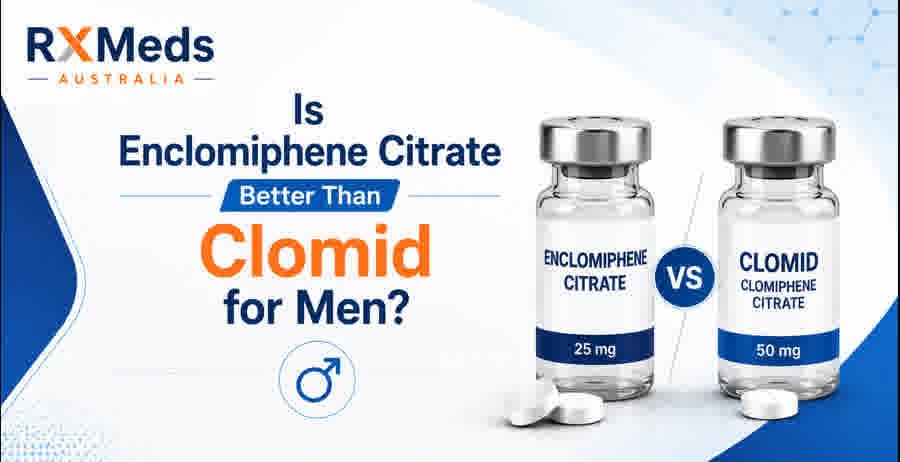
Men researching low testosterone treatment often come across two similar names: Enclomiphene Citrate and Clomid (Clomiphene Citrate). Both belong to the selective estrogen receptor modulator (SERM) class and have been studied for their potential to stimulate the body’s natural testosterone production.
But is Enclomiphene Citrate better than Clomid for men?
Short answer: Enclomiphene Citrate may offer advantages over Clomid for some men because it is designed to provide the enclomiphene isomer without the zuclomiphene component found in Clomiphene Citrate. Some men may prefer this approach because of potential differences in hormone effects and tolerability. However, there is no universal “better” option, and the best treatment depends on the cause of low testosterone, fertility goals, medical history, and individual response.
This article explains the key differences between Enclomiphene Citrate vs Clomid, how each works, potential benefits and side effects, and what men should consider before choosing a treatment.
Enclomiphene Citrate vs Clomid: What Is the Difference?
The primary difference is their composition.
Clomiphene Citrate, commonly known by the brand name Clomid, is a mixture of two stereoisomers: enclomiphene and zuclomiphene.
Enclomiphene Australia tablet is the trans-isomer of clomiphene, while zuclomiphene is the cis-isomer.
Both medicines are associated with the SERM class and can influence estrogen signalling in the hypothalamus and pituitary gland. By reducing estrogen’s feedback signal in these areas, they may encourage the body to increase production of luteinizing hormone (LH) and follicle-stimulating hormone (FSH).
These hormones can stimulate the testes to produce more testosterone and support sperm production.
The key difference is that Enclomiphene is intended to focus on the enclomiphene component rather than delivering the combination of both isomers found in Clomid.
How Does Enclomiphene Work for Men?
Enclomiphene Citrate works by influencing the hormonal signalling pathway that regulates testosterone production.
In men with certain forms of secondary hypogonadism, the brain may not provide sufficient hormonal stimulation to the testes.
Enclomiphene may help increase the signalling hormones:
- LH
- FSH
In turn, these hormones can stimulate the testes to produce testosterone naturally.
This mechanism differs from traditional testosterone replacement therapy (TRT), which introduces external testosterone into the body.
One potential reason men consider Enclomiphene is fertility. Exogenous testosterone can suppress LH and FSH production and reduce sperm production in some men. By stimulating the body’s own hormonal pathway, Enclomiphene may be considered when maintaining fertility is an important treatment goal.
However, Enclomiphene is not appropriate for every type of testosterone deficiency.
How Does Clomid Work in Men?
Clomid works through a similar hormonal pathway but contains both enclomiphene and zuclomiphene isomers.
Although Clomid is widely known for its use in female fertility treatment, it has also been used off-label in men for conditions involving low testosterone and fertility concerns.
In men, Clomid may:
- Increase LH
- Increase FSH
- Stimulate natural testosterone production
- Support sperm production in some patients
Because Clomid contains two isomers with different pharmacological properties, some clinicians and patients have questioned whether the zuclomiphene component contributes to unwanted estrogenic effects or side effects in certain individuals.
This is one reason why Enclomiphene vs Clomid for male testosterone has become a popular topic among men researching hormone treatment.
Enclomiphene vs Clomid: Quick Comparison
| Feature | Enclomiphene Citrate | Clomid |
|---|---|---|
| Composition | Enclomiphene isomer | Enclomiphene + zuclomiphene |
| Testosterone pathway | Stimulates endogenous production | Stimulates endogenous production |
| Fertility consideration | May preserve sperm production | May support sperm production |
| Male use | Investigated for male hypogonadism | Used off-label in some men |
Is Enclomiphene Better Than Clomid for Men?
Enclomiphene may be preferable for some men, but current evidence does not establish that it is universally better than Clomid.
The potential advantages of Enclomiphene are primarily related to its more selective composition.
Some men may experience unwanted effects while using Clomid, potentially related to the presence of zuclomiphene. Enclomiphene is designed to isolate the isomer associated with stimulating the hypothalamic-pituitary-gonadal axis.
Potential reasons a healthcare professional might consider Enclomiphene include:
- Low testosterone associated with secondary hypogonadism
- Desire to maintain endogenous testosterone production
- Fertility preservation concerns
- Interest in an oral treatment approach
- Poor tolerance of Clomid in some cases
However, treatment decisions should be based on clinical evaluation rather than marketing claims.
Enclomiphene vs Clomid for Fertility
Both Enclomiphene and Clomid may be considered in certain men who want to improve testosterone levels while maintaining fertility.
This is an important distinction from conventional testosterone replacement therapy.
TRT can suppress the body’s natural production of LH and FSH. Because these hormones are important for sperm production, testosterone therapy may reduce sperm count in some men.
SERMs such as Clomid and Enclomiphene work differently by stimulating the body’s hormonal signalling pathway.
However, fertility treatment should be individualised.
Men actively trying to conceive may benefit from consultation with:
- An endocrinologist
- A urologist
- An andrologist
- A reproductive specialist
A semen analysis may also be appropriate depending on the clinical situation.
Which Has Fewer Side Effects: Enclomiphene or Clomid?
Enclomiphene may be better tolerated by some men, but individual responses vary, and more research is needed to establish clear long-term superiority.
Clomid has been associated with potential side effects such as:
- Headaches
- Mood changes
- Hot flashes
- Nausea
- Visual disturbances
- Changes in estrogen-related symptoms
Enclomiphene may also cause side effects, and it should not be considered risk-free simply because it contains a single isomer.
Any changes in vision should be reported promptly to a healthcare professional.
Regular medical monitoring can help evaluate testosterone levels, estradiol, LH, FSH, symptoms, and other relevant health markers.
Enclomiphene vs Clomid: Potential Advantages
| Consideration | Enclomiphene | Clomid |
| Isomer composition | Single targeted isomer | Two-isomer combination |
| Natural testosterone | Designed to stimulate production | Can stimulate production |
| Fertility goals | May be considered | Common off-label consideration |
| Tolerability | May be preferable for some men | Side effects vary individually |
Who May Benefit From Enclomiphene?
Enclomiphene may be considered for men with secondary hypogonadism who want to increase testosterone while maintaining the body’s natural hormone signalling.
Potential candidates may include men who:
- Have consistently low testosterone levels
- Have symptoms associated with testosterone deficiency
- Have secondary rather than primary hypogonadism
- Want to preserve fertility
- Prefer an oral treatment approach
- Have discussed treatment options with a qualified healthcare professional
However, men with primary hypogonadism, where the testes themselves cannot adequately produce testosterone, may not respond in the same way.
A proper diagnosis is therefore essential.
Is Enclomiphene Safer Than Clomid?
It is not accurate to say that Enclomiphene is automatically safer than Clomid for every man.
Safety depends on factors including:
- Underlying medical condition
- Dose
- Treatment duration
- Other medications
- Hormone levels
- Individual response
- Medical supervision
Men should not self-medicate with Enclomiphene or Clomid obtained from unverified online sources.
Product quality, dosage accuracy, and regulatory status are particularly important when purchasing medicines online.
What Should You Consider Before Choosing?
If you are comparing Enclomiphene Citrate vs Clomid for men, consider the following:
1. Your Diagnosis
Determine whether you have primary or secondary hypogonadism.
2. Your Fertility Goals
Tell your healthcare professional if you are trying to conceive now or plan to have children in the future.
3. Your Hormone Levels
Testing may include testosterone, LH, FSH, estradiol, SHBG, and other relevant markers.
4. Your Medical History
Existing health conditions and medications can influence treatment decisions.
5. Your Response to Treatment
Follow-up testing is important to determine whether treatment is working effectively.
Enclomiphene vs Clomid: Which Should You Choose?
| Situation | Potential Consideration | Next Step |
| Low testosterone | Enclomiphene or Clomid may be discussed | Confirm diagnosis |
| Fertility concerns | SERMs may be considered | Discuss with fertility specialist |
| Primary hypogonadism | SERMs may be less suitable | Investigate alternative treatment |
| Side effects from Clomid | Enclomiphene may be discussed | Consult prescribing clinician |
FAQs
1. Is Enclomiphene better than Clomid for men?
Short answer: Enclomiphene may be preferable for some men, but there is no universal answer. The best option depends on testosterone levels, diagnosis, fertility goals, and individual response.
2. What is the main difference between Enclomiphene and Clomid?
Short answer: Clomid contains two isomers, enclomiphene and zuclomiphene, while Enclomiphene focuses on the enclomiphene isomer.
3. Does Enclomiphene increase testosterone?
Short answer: Enclomiphene is intended to stimulate the body’s natural testosterone production by influencing LH and FSH signalling.
4. Is Enclomiphene better for fertility than TRT?
Short answer: Enclomiphene may be considered when fertility preservation is important because it stimulates endogenous hormone production, whereas TRT can suppress sperm production.
5. Does Clomid work for low testosterone in men?
Short answer: Clomid has been used off-label in some men to stimulate natural testosterone production, particularly in certain cases of secondary hypogonadism.
6. Does Enclomiphene have fewer side effects than Clomid?
Short answer: Some men may tolerate Enclomiphene better, but side effects can occur with both treatments and individual responses vary.
7. Can Enclomiphene replace testosterone replacement therapy?
Short answer: It may be an alternative for some men, but it is not suitable for everyone and does not work through the same mechanism as TRT.
8. Which is better for male fertility, Clomid or Enclomiphene?
Short answer: Both may be considered in selected men, but the appropriate treatment depends on hormone levels, sperm production, fertility goals, and the underlying cause of infertility.
9. Can men take Enclomiphene and Clomid together?
Short answer: They should not be combined unless specifically directed by a qualified healthcare professional. Both affect the same hormonal pathway, and combining them may increase risks without providing additional benefit.
10. Should I choose Enclomiphene or Clomid for low testosterone?
Short answer: Do not choose based solely on online comparisons. A healthcare professional should evaluate your testosterone levels, underlying diagnosis, fertility goals, and medical history before recommending treatment.
Conclusion
Enclomiphene Citrate may be better than Clomid for some men, but there is no universal winner. Both can stimulate natural testosterone production and may be considered for certain cases of secondary hypogonadism. Enclomiphene focuses on the enclomiphene isomer, while Clomid contains both enclomiphene and zuclomiphene. The right choice depends on testosterone levels, fertility goals, medical history, potential side effects, and professional monitoring.