Enclomiphene citrate has become an increasingly discussed option in conversations about low testosterone, male hypogonadism, and fertility preservation. As a selective estrogen receptor modulator (SERM), enclomiphene takes a different approach from traditional testosterone replacement therapy (TRT): instead of supplying testosterone externally, it aims to encourage the body’s own hormonal system to increase testosterone production.
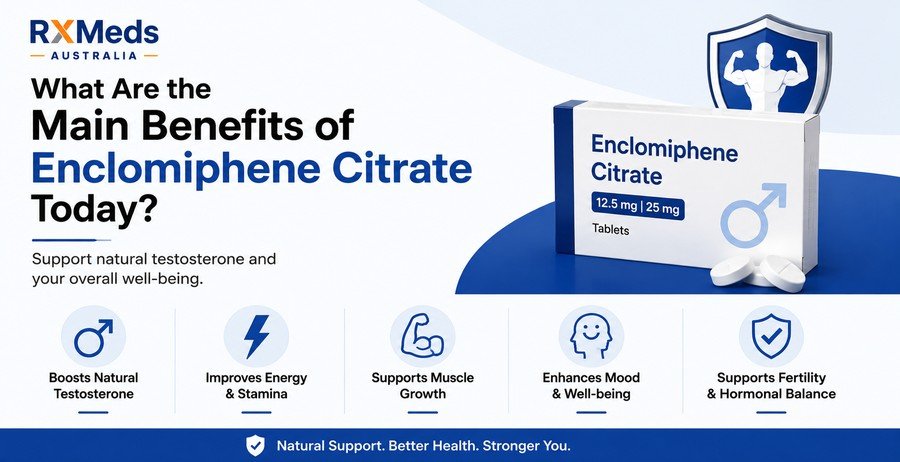
So, what are the main benefits of enclomiphene citrate today? Current clinical evidence suggests that its most relevant potential advantages include supporting endogenous testosterone production, maintaining sperm production, increasing LH and FSH signaling, and providing an oral alternative to testosterone therapy for appropriately selected men. However, it is important to distinguish clinical research from regulatory approval and established medical indications.
What Is Enclomiphene Citrate?
Enclomiphene is the trans-isomer of clomiphene citrate, a medication containing two geometric isomers: enclomiphene and zuclomiphene. FDA documentation describes clomiphene as containing both forms.
Enclomiphene belongs to the SERM class. Its proposed role in men with secondary hypogonadism is to modify estrogen feedback within the hypothalamic-pituitary-gonadal (HPG) axis. This can increase signaling through luteinizing hormone (LH) and follicle-stimulating hormone (FSH), which in turn can stimulate the testes.
| Potential Benefit | Why It Matters | Evidence |
|---|---|---|
| Testosterone support | Encourages endogenous testosterone production | Clinical trials |
| Fertility preservation | Sperm production can be maintained | Randomized trials |
| LH/FSH support | Maintains reproductive hormone signaling | Clinical studies |
| Oral administration | Does not require testosterone injections or gels | Formulation characteristic |
1. Supports Natural Testosterone Production
One of the primary reasons enclomiphene citrate has attracted attention is its ability to increase endogenous testosterone production.
In clinical research involving men with secondary hypogonadism, enclomiphene Australia increased testosterone while also increasing LH. Researchers have therefore investigated it as a testosterone-restoration strategy rather than a testosterone-replacement strategy.
This distinction is important. With TRT, testosterone is introduced externally. With enclomiphene, the intended mechanism is to stimulate the body’s existing HPG axis.
A 2025 systematic review and meta-analysis of randomized controlled trials found that SERM treatment significantly improved total testosterone, LH, and FSH compared with placebo. The analysis also found no significant difference in total testosterone between SERM therapy and testosterone gel, although the underlying studies had limitations and substantial heterogeneity.
2. May Help Preserve Sperm Production
For men concerned about fertility, one of the most important potential benefits of enclomiphene is its effect on sperm production.
Exogenous testosterone can suppress the hormonal signals involved in spermatogenesis. Enclomiphene has been studied partly because it can increase testosterone while maintaining LH and FSH signaling.
In randomized trials of men with secondary hypogonadism, enclomiphene increased testosterone while preserving sperm counts, in contrast to topical testosterone therapy.
This makes enclomiphene for male fertility an important long-tail search topic, although individual fertility outcomes depend on the underlying cause of low testosterone and other reproductive factors.
3. Increases LH and FSH Signaling
LH and FSH are central components of male reproductive physiology.
LH stimulates testosterone production in the Leydig cells of the testes, while FSH plays an important role in supporting spermatogenesis. Because enclomiphene works through the HPG axis, studies have observed increases in these gonadotropins.
The available evidence therefore suggests that enclomiphene may offer a different hormonal profile from exogenous testosterone, which can suppress LH and FSH through negative feedback.
4. May Be Relevant for Secondary Hypogonadism
Enclomiphene is primarily investigated in the context of secondary hypogonadism, where low testosterone is associated with inadequate signaling from the hypothalamus or pituitary.
This distinction is critical. A treatment that relies on stimulating the testes through the HPG axis may not be appropriate for men whose low testosterone is caused by primary testicular failure.
Clinical trials have specifically enrolled men with low testosterone and low or inappropriately normal LH, reflecting the type of hormonal profile associated with secondary hypogonadism.
| Situation | Enclomiphene Relevance |
|---|---|
| Secondary hypogonadism | Potentially relevant |
| Fertility preservation | Potential advantage |
| Primary testicular failure | May be less suitable |
| Unexplained low testosterone | Requires medical evaluation |
5. Provides an Oral Alternative to Testosterone Replacement
Another potential benefit is convenience. Enclomiphene has been investigated as an oral therapy, whereas conventional TRT can involve injections, topical gels, patches, or other testosterone formulations.
For some patients, an oral approach that stimulates endogenous testosterone may be attractive. However, convenience should not be interpreted as proof of superior safety or effectiveness.
The FDA confirms that approved testosterone products include several formulations, while enclomiphene itself does not currently have an FDA-approved drug product in the United States.
Enclomiphene vs. Testosterone Replacement Therapy
The biggest conceptual difference is how the two approaches affect the HPG axis.
| Factor | Enclomiphene | Testosterone Therapy |
|---|---|---|
| Primary approach | Stimulates endogenous production | Supplies testosterone |
| LH/FSH | Can increase | Can be suppressed |
| Sperm production | May be preserved | Can be impaired |
| Administration | Oral in clinical studies | Several formulations |
| FDA-approved enclomiphene product | No | Yes, for specific indications |
Research comparing enclomiphene with topical testosterone has found similar improvements in testosterone in studied populations while showing different effects on gonadotropins and sperm production.
Is Enclomiphene Citrate FDA Approved?
This is one of the most important questions surrounding enclomiphene.
No FDA-approved drug product containing enclomiphene citrate is currently available in the United States. FDA briefing material specifically states that there were no FDA-approved drug products containing enclomiphene as the active ingredient when the agency reviewed the compound.
That status is different from clomiphene citrate, which is an FDA-approved medication with an established label. Clomiphene contains both enclomiphene and zuclomiphene isomers.
Therefore, consumers should be cautious with marketing claims describing enclomiphene as an “FDA-approved testosterone treatment.”
What Does the Research Say About Enclomiphene Benefits?
The clinical evidence is promising but should be interpreted carefully.
Randomized studies have demonstrated increases in testosterone and preservation of sperm production in selected men with secondary hypogonadism. A more recent meta-analysis of randomized trials involving SERMs also found improvements in testosterone, LH, and FSH.
However, long-term evidence remains less extensive than the evidence base for established testosterone therapies. Individual responses can also vary according to age, body composition, underlying disease, baseline hormone levels, fertility status, and the cause of hypogonadism.
Safety and Medical Considerations
Potential benefits should always be considered alongside potential risks.
Because enclomiphene affects estrogen signaling and reproductive hormones, medical supervision is important. Hormonal treatment should generally be based on an appropriate clinical evaluation rather than a single testosterone measurement.
Before considering treatment, clinicians may evaluate testosterone levels alongside LH, FSH and other relevant laboratory or clinical factors. Fertility goals are particularly important when selecting between testosterone replacement and fertility-preserving strategies.
Frequently Asked Questions
1. What is enclomiphene citrate?
Enclomiphene citrate is a SERM and the trans-isomer of clomiphene citrate that has been studied for male hypogonadism.
2. Does enclomiphene increase testosterone?
Clinical studies show that enclomiphene can increase testosterone levels in selected men with secondary hypogonadism.
3. Can enclomiphene preserve fertility?
Research suggests it can preserve sperm production while increasing testosterone in appropriately selected men.
4. Is enclomiphene the same as clomiphene?
No. Clomiphene contains both enclomiphene and zuclomiphene, whereas enclomiphene refers to the trans-isomer.
5. Is enclomiphene a form of TRT?
Not technically. Enclomiphene is intended to stimulate endogenous testosterone production, while TRT supplies testosterone externally.
6. Does enclomiphene increase LH and FSH?
Yes. Clinical studies have reported increases in LH and FSH alongside testosterone increases.
7. Who has been studied with enclomiphene?
Clinical trials have primarily examined men with secondary hypogonadism and low testosterone, including overweight men in some studies.
8. Can enclomiphene replace testosterone therapy?
It may be considered as an alternative strategy in selected patients, but it is not appropriate for everyone and requires individualized medical assessment.
9. Should you take enclomiphene without medical supervision?
No. Hormonal therapy should be evaluated and monitored by a qualified healthcare professional, particularly when fertility or underlying endocrine disorders are involved.
Conclusion
The main potential benefits of enclomiphene citrate center on its ability to stimulate the body’s own testosterone-production pathway while maintaining reproductive hormone signaling. Research has shown increases in testosterone, LH, and FSH, with clinical trials also demonstrating preservation of sperm production in selected men with secondary hypogonadism.
Its fertility-preserving potential is arguably its most distinctive advantage compared with conventional testosterone replacement. Nevertheless, enclomiphene should not be presented as a universally appropriate testosterone treatment, and its lack of an FDA-approved drug product in the United States is an important consideration.
For anyone researching enclomiphene benefits, enclomiphene vs TRT, enclomiphene for low testosterone, or enclomiphene for male fertility, the most useful approach is to evaluate the underlying cause of low testosterone, fertility goals, laboratory findings, treatment risks, and the quality of available clinical evidence rather than relying on marketing claims.