Erectile dysfunction (ED) medicines can be highly effective for many men, but their results are not always identical from one person to another—or even from one occasion to the next. One day, an ED medicine may seem to work very well, while another time the erection may not be as firm or may not last as long. This does not necessarily mean that the medication has stopped working.
So, why can ED medicine results vary?
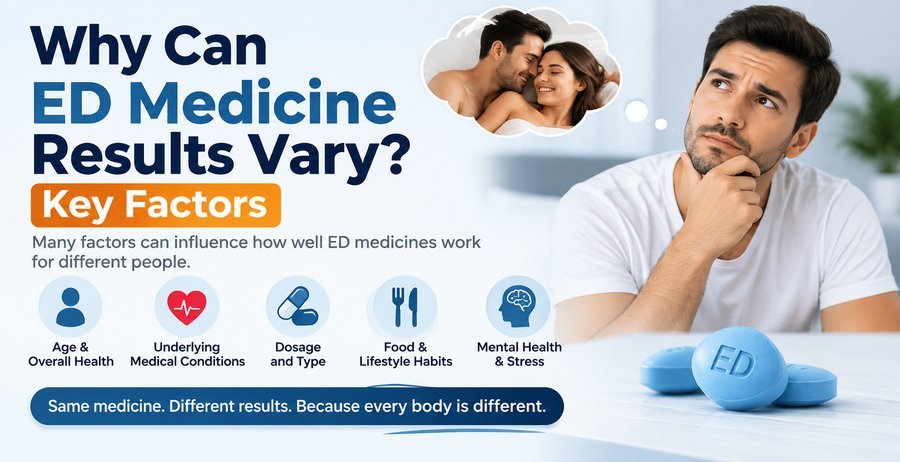
Several factors can influence the effectiveness of erectile dysfunction medication, including the type and dosage of medicine, timing, food, alcohol, sexual stimulation, stress, anxiety, underlying health conditions, and interactions with other medications. Individual response also plays an important role because the causes and severity of ED differ from person to person.
Understanding these factors can help explain why ED medicine results vary and why a medication that works well for one person may produce different results for someone else.
Important: ED medicines should be used according to the instructions of a qualified healthcare professional. If a medication is not producing the expected results or is causing significant side effects, speak with a healthcare professional rather than changing the dose yourself.
What Is ED Medicine and How Does It Work?
Most commonly prescribed ED medicines belong to a group called phosphodiesterase type 5 (PDE5) inhibitors. Examples include sildenafil, tadalafil, vardenafil, and avanafil.
These medicines help improve the body’s natural erectile response by supporting blood flow to the penis when a man becomes sexually stimulated.
During sexual arousal, the body releases nitric oxide. This contributes to a series of chemical reactions that relax blood vessels and increase blood flow into the penis. PDE5 inhibitors help maintain this process by blocking the PDE5 enzyme.
However, ED medicine does not automatically create an erection simply because someone takes a tablet. Sexual stimulation is generally still required.
The response can therefore depend on several factors, including:
- The underlying cause of ED
- The specific medication being used
- The prescribed dosage
- Timing of the dose
- Food intake
- Alcohol consumption
- Stress and anxiety
- Other medications
- Existing health conditions
- Individual response to treatment
This explains why erectile dysfunction medication effectiveness can differ between individuals.
Why Can ED Medicine Results Vary From Person to Person?
One of the biggest reasons ED medicine results vary is that erectile dysfunction does not have one single cause.
ED can be associated with physical, psychological, hormonal, vascular, neurological, or medication-related factors. Some men may have mild, occasional erection difficulties, while others may have persistent ED associated with conditions such as diabetes or cardiovascular disease.
Common factors that can influence ED medication results include:
- Underlying cause of ED
- Severity of erectile dysfunction
- Overall cardiovascular health
- Diabetes and blood sugar control
- Blood pressure
- Stress and anxiety
- Sexual stimulation
- Medication dosage
- Timing
- Food and alcohol
- Other medications
- Individual sensitivity and response
Therefore, comparing one person’s experience with another person’s experience may not accurately predict how a particular ED medicine will work.
What Factors Affect ED Medication Effectiveness?
1. The Underlying Cause of Erectile Dysfunction
The cause of ED can strongly influence treatment response.
For example, erection problems associated primarily with temporary stress may behave differently from ED related to long-term vascular disease or diabetes.
ED can be associated with:
- Reduced blood flow
- Diabetes
- High blood pressure
- Cardiovascular disease
- Obesity
- Hormonal problems
- Nerve-related conditions
- Certain medications
- Anxiety and stress
- Relationship or psychological factors
When an underlying condition contributes significantly to ED, treating or managing that condition may also be an important part of improving erectile function.
This is one reason why ED treatment effectiveness can differ significantly between individuals.
2. The Specific ED Medication
Not every ED medicine works in exactly the same way or lasts for the same amount of time.
Common PDE5 inhibitors include:
| ED Medicine | Active Ingredient | General Consideration |
|---|---|---|
| Sildenafil | Sildenafil | Often used before sexual activity |
| Tadalafil | Tadalafil | Has a longer duration of action |
| Vardenafil | Vardenafil | Another PDE5 inhibitor option |
| Avanafil | Avanafil | Designed for relatively rapid onset |
Individual response can differ between medications.
A person who experiences limited benefit from one medication may respond differently to another. However, switching medications or changing doses should be discussed with a healthcare professional.
3. Dosage Can Affect Results
ED medicine dosage is another important factor.
A dose that is appropriate for one person may not be appropriate for another. Age, health conditions, other medications, kidney or liver function, and individual tolerance can all influence prescribing decisions.
Taking more medicine does not automatically produce a better erection.
In fact, increasing the dose without medical advice can increase the risk of side effects.
If your ED pills are not working, the appropriate response is not necessarily to take more. A healthcare professional can evaluate whether the problem relates to dosage, timing, medication choice, underlying health conditions, or another factor.
Does Timing Affect ED Medicine Results?
Yes, timing can influence the experience with some ED medicines.
Different medications have different pharmacokinetic profiles, meaning they are absorbed, distributed, metabolized, and eliminated differently.
Some ED medicines are generally taken before sexual activity, while tadalafil may be prescribed in different dosing patterns depending on the individual.
Taking a medication too close to sexual activity may not provide enough time for it to reach its effective level.
At the same time, taking it much earlier than recommended may also affect how the timing aligns with sexual activity.
Always follow the timing instructions provided by your healthcare professional or medication label.
Does Food Affect ED Medicine Effectiveness?
Food can affect how quickly some ED medicines are absorbed.
A particularly large or high-fat meal may delay the absorption of certain medications, potentially affecting how quickly their effects are noticed.
This does not necessarily mean the medication has become ineffective.
The effect of food depends on the specific medicine.
For this reason, read the medication instructions carefully and follow the directions provided by your healthcare professional.
If you notice that your ED medicine seems less effective after certain meals, discuss the pattern with a healthcare professional rather than changing the dose yourself.
Can Alcohol Affect ED Medication Results?
Alcohol can affect erectile function independently of ED medication.
Higher alcohol consumption can interfere with sexual arousal, nervous-system function, blood pressure, and the ability to maintain an erection.
This means alcohol may make it harder to determine whether an ED medicine is working effectively.
Depending on the specific medication and individual health circumstances, alcohol may also increase the likelihood of certain side effects such as dizziness or a drop in blood pressure.
Therefore, alcohol can be one reason ED medication results vary from one occasion to another.
If you are taking an ED medicine, ask your healthcare professional about alcohol use and any potential interactions relevant to your medication.
Can Stress and Anxiety Affect ED Medicine Results?
Yes.
Psychological factors can have a significant influence on erectile function.
Stress, anxiety, relationship concerns, and performance anxiety can interfere with the physiological processes involved in achieving and maintaining an erection.
For example, someone may take an ED medicine expecting an immediate and perfect result. If they become worried about whether the medication will work, that anxiety itself can interfere with sexual arousal.
This can create a cycle:
ED → worry about performance → increased anxiety → difficulty with arousal → erection problems
Consequently, stress and erectile dysfunction can sometimes contribute to inconsistent treatment results.
Managing psychological factors may therefore be an important part of an overall ED treatment plan.
Does Sexual Stimulation Affect How ED Medicine Works?
Yes.
PDE5 inhibitors do not generally cause an automatic erection without sexual stimulation.
The medication supports the body’s natural erectile response, but sexual arousal still plays an important role.
Factors such as:
- Sexual desire
- Physical stimulation
- Emotional connection
- Anxiety
- Fatigue
- Relationship circumstances
may influence the quality of an erection.
Therefore, if someone takes ED medication without adequate sexual stimulation and does not experience an erection, that does not necessarily mean the medication has failed.
Can Health Conditions Change Your Response to ED Medicine?
Yes.
Underlying health conditions can affect both erectile function and the response to ED treatment.
Diabetes
Diabetes can damage blood vessels and nerves over time, both of which are important for normal erections.
Men with diabetes may therefore experience more complex or persistent ED.
High Blood Pressure
High blood pressure can affect blood vessels and cardiovascular health, potentially contributing to erectile dysfunction.
Cardiovascular Disease
Because erections depend heavily on healthy blood vessels and adequate blood flow, cardiovascular health is closely connected to erectile function.
Obesity
Obesity may be associated with several factors that contribute to ED, including cardiovascular risk, metabolic problems, inflammation, and hormonal changes.
Hormonal Issues
Hormonal factors, including low testosterone in some individuals, may contribute to sexual difficulties.
Because multiple factors can coexist, treating ED may sometimes require more than simply taking a tablet.
Why Is My ED Medication Not Working Every Time?
This is a common question.
If ED medication is not working every time, several explanations are possible.
The medication may still be working, but other factors may be affecting the result.
Potential factors include:
- Incorrect timing
- Large meal before taking certain medications
- Excessive alcohol
- Insufficient sexual stimulation
- Stress or anxiety
- Fatigue
- Changes in health
- Incorrect medication use
- Drug interactions
- Underlying medical conditions
- Expectations about the medication
Occasional variation does not automatically mean that an ED medicine has stopped working.
However, if the problem happens repeatedly, it is worth discussing with a healthcare professional.
Can Other Medications Affect ED Medicine Results?
Yes.
Some prescription and over-the-counter medicines can affect sexual function or interact with ED medications.
This is particularly important because certain combinations can cause significant drops in blood pressure.
For example, PDE5 inhibitors can interact dangerously with nitrate medicines, which are commonly used for certain heart conditions.
Other medications may also affect erectile function itself.
Therefore, always tell your healthcare professional about all medicines and supplements you take before starting an ED medication.
Do not assume that a medication or supplement is safe to combine simply because it is available without a prescription.
Why Does Sildenafil Work Differently for Different People?
Sildenafil is one of the best-known PDE5 inhibitors, but its effects can still vary.
Factors that may influence sildenafil effectiveness include:
- Dose
- Timing
- Food
- Alcohol
- Sexual stimulation
- Cardiovascular health
- Diabetes
- Stress
- Anxiety
- Other medications
- Individual response
For example, taking sildenafil after a large meal may delay its absorption in some circumstances.
Similarly, taking sildenafil while experiencing significant performance anxiety may produce a different experience than taking it in a relaxed situation.
This does not mean the medication is unreliable. It means that erectile function involves several biological and psychological processes.
Why Does Tadalafil Not Work Every Time?
Tadalafil is another commonly used PDE5 inhibitor.
One of its notable characteristics is its relatively long duration of action compared with some other ED medicines.
However, a longer duration does not mean that every sexual encounter will automatically result in an erection.
Sexual stimulation, health status, medication use, stress, and the underlying cause of ED can still influence the outcome.
If tadalafil appears to be producing inconsistent results, a healthcare professional can review how it is being used and whether another factor may be contributing to the problem.
Does Age Affect ED Medicine Results?
Age itself does not necessarily mean that ED medication will stop working.
However, aging is associated with a greater likelihood of certain conditions that can affect erectile function, including cardiovascular disease, diabetes, high blood pressure, and medication use.
Older adults may also metabolize some medicines differently because of changes in kidney or liver function.
Therefore, treatment decisions should consider overall health rather than age alone.
Can Lifestyle Factors Influence ED Treatment Results?
Yes.
Lifestyle factors can influence erectile function and general cardiovascular health.
Helpful habits may include:
- Maintaining a healthy weight
- Exercising regularly
- Eating a balanced diet
- Getting adequate sleep
- Managing stress
- Avoiding tobacco
- Limiting excessive alcohol
- Managing diabetes and blood pressure
- Following prescribed treatment plans
These lifestyle changes do not replace medically appropriate ED treatment, but they can support overall health and erectile function.
What Should You Do If Your ED Medicine Is Not Working?
If your ED medication does not produce the expected results, avoid immediately increasing the dose.
Instead, consider discussing the following with your healthcare professional:
- How you are taking the medication
- The prescribed dose
- Timing relative to sexual activity
- Food and alcohol consumption
- Other medicines you take
- Existing medical conditions
- Stress or anxiety
- Whether another ED treatment may be appropriate
A healthcare professional may determine whether the issue is related to medication use, an underlying condition, psychological factors, or the need for a different treatment strategy.
When Should You Seek Medical Advice?
Occasional erection difficulties can happen for many reasons. However, persistent or worsening ED deserves medical attention.
Seek professional advice if:
- ED happens frequently
- Your medication consistently produces little or no benefit
- Your erection problems are getting worse
- You experience concerning side effects
- You have cardiovascular risk factors
- You have diabetes or high blood pressure
- You take multiple medications
- You are unsure whether your ED medicine is safe for you
ED can sometimes be an early indicator of underlying cardiovascular or metabolic problems, so persistent symptoms should not simply be ignored.
Frequently Asked Questions About ED Medicine Results
1. Why can ED medicine results vary?
ED medicine results can vary because of differences in dosage, timing, food, alcohol, sexual stimulation, stress, health conditions, other medications, and individual response.
2. Why does ED medicine work for some people but not others?
People can have different causes and severity of erectile dysfunction. Cardiovascular health, diabetes, psychological factors, medications, and individual biology can all affect treatment response.
3. Why is my ED medicine not working every time?
Inconsistent results may be related to timing, food, alcohol, stress, sexual stimulation, health conditions, medication interactions, or individual response.
4. Does food affect ED medicine?
Food can affect the absorption of some ED medicines. A large or high-fat meal may delay absorption of certain medications.
5. Does alcohol affect ED medication effectiveness?
Alcohol can negatively affect erectile function and may also increase certain medication-related side effects. Discuss alcohol use with your healthcare professional.
6. Does stress affect ED medicine results?
Yes. Stress and performance anxiety can interfere with sexual arousal and erectile function, potentially affecting the overall treatment experience.
7. Does sexual stimulation matter when taking ED medicine?
Yes. PDE5 inhibitors generally support the body’s natural response to sexual stimulation rather than automatically producing an erection.
8. Can health conditions affect ED medicine effectiveness?
Yes. Conditions such as diabetes, cardiovascular disease, high blood pressure, obesity, and certain hormonal or neurological problems can affect erectile function and treatment response.
9. Should I take a higher dose if my ED medicine does not work?
No. Do not increase your dose without medical advice. A healthcare professional should determine whether the dose, medication, timing, or another factor needs to be addressed.
10. What should I do if my ED medicine is consistently ineffective?
Speak with a healthcare professional. They can review your medication, dosage, health conditions, other medicines, and possible causes of ED and determine an appropriate treatment approach.
Conclusion
So, why can ED medicine results vary? The answer is that erectile function depends on much more than medication alone.
The effectiveness of an ED medicine can be influenced by the underlying cause of erectile dysfunction, medication type, dosage, timing, food, alcohol, sexual stimulation, stress, anxiety, existing health conditions, other medicines, and individual response.
Sildenafil, tadalafil, vardenafil, and avanafil are all PDE5 inhibitors, but their effects can differ between individuals. Even when the same medication is used by the same person, results may sometimes vary because circumstances surrounding sexual activity can change.
If your ED pills are not working consistently, avoid assuming that taking a higher dose is the answer. Instead, discuss the issue with a qualified healthcare professional. They can determine whether the problem relates to medication use, an underlying condition, interactions, psychological factors, or another aspect of your sexual health.
Understanding these factors can help set realistic expectations and support safer, more informed management of erectile dysfunction.